
Tom Mannell
About
I’m a developer and technical consultant with experience across not-for-profits, healthcare organizations, public sector teams, and small businesses. My work focuses on backend-heavy web applications, internal dashboards, automation, and data systems that support real decision-making.I work collaboratively, shifting between hands-on development and technical advisory depending on what makes sense for the project. My focus is on clarity, sustainability, and helping teams make sound technical choices and build systems that remain dependable over time.
Services
Backend & Internal Web Systems
Designing, building, and extending backend-heavy web applications, internal tools, dashboards, automation, and integrations.
Data, Analytics & Reporting
Structuring, moving, and working with data to support reporting, dashboards, analytics, and operational decision-making.
Proof of Concept & Technical Validation
Hands-on prototyping to test ideas, workflows, and technical approaches before committing to a build, framework or platform.
Technical Advisory & Software Selection
Architecture reviews, build–vs–buy decisions, software selection and practical governance guidance to support sustainable use (e.g., software management, data ownership, and decision boundaries).
Handoff & Sustainability
Documentation, runbooks, SOPs, CI/CD setup, mentoring, and operational guidance to ensure systems can be understood, maintained, and operated independently.
Featured Project
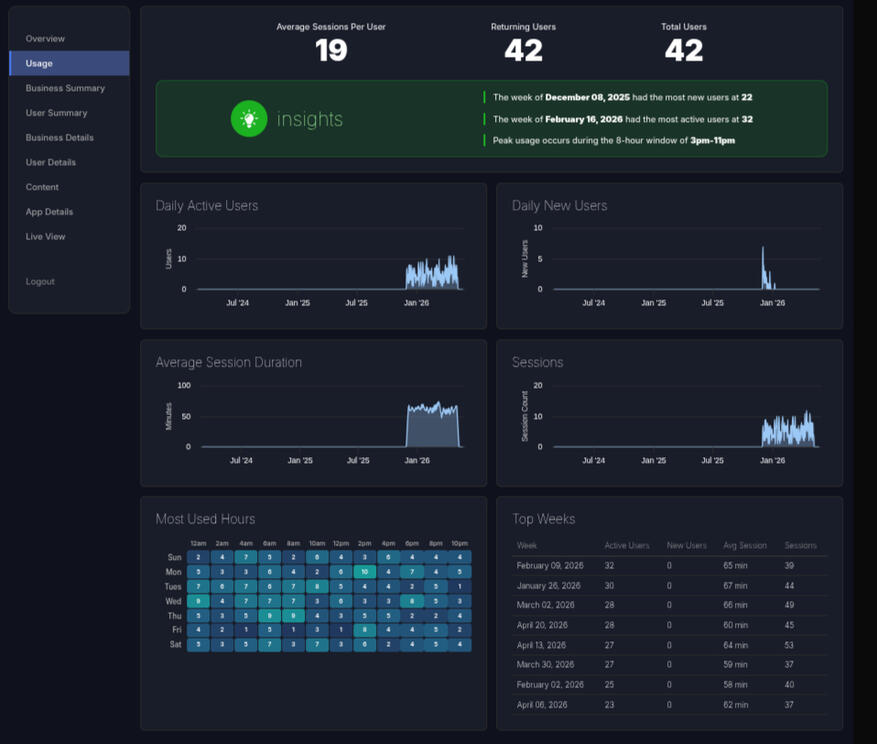
Enterprise Analytics Platform
My client had a vision of building a shared analytics platform providing meaningful insights across the applications they develop for their customers.
Contact
If you have a scoped project, system challenge, or need technical guidance, feel free to get in touch.Engagements are typically hourly or project-based, depending on scope and preferred way of working.You can reach me at:
[email protected]
or use the form below
Enterprise Analytics Platform
A private client had a vision of building a shared analytics platform providing meaningful insights into the enterprise applications they develop for their customers. The idea was to provide visibility into usage and engagement while creating a foundation future applications could plug into.


The Problem
Part of my client's work involves building custom applications for enterprise customers, used at trade shows, sales meetings, and product demonstrations. The applications delivered engaging experiences, but measuring impact and usage was difficult. There was limited visibility into how users interacted with the software and whether customers were seeing value from their investment.They needed an analytics platform capable of collecting usage data across clients and applications, surfacing insights through dashboards. Keeping client data secure and isolated was a key requirement as well as ensuring future applications would also plug into the same system.
What Was Built
A multi-tenant analytics platform providing each customer with their own isolated analytics environment, including separate databases, credentials, and dashboards.Customer applications were updated to send usage events to a centralized ingestion API. Events are processed, stored, and surfaced through dashboards providing live activity monitoring and historical analytics.
Key Technical Decisions
Database isolation by tenant
Rather than storing all customer data in a shared database with tenant identifiers, each client operates within an isolated PostgreSQL database.The goal was simple: reduce cross-tenant data exposure and make ownership boundaries clear. If a customer wanted their data removed, there was no complex offboarding process. Remove the database and its backups, and the job is done.Serverless AWS architecture
The platform runs on AWS Lambda behind API Gateway, allowing infrastructure to scale automatically without dedicated servers.Infrastructure costs remain low during periods of low activity while still supporting spikes in event volume during active campaigns.Real-time analytics delivery
Live dashboards use WebSocket connections managed through API Gateway, with DynamoDB maintaining connection state between Lambda executions.Incoming events are routed immediately to active dashboards, giving clients near real-time visibility into application usage.
AI-assisted delivery
AI tooling was a requirement for this project. My client wanted a platform they could continue to support and extend independently using AI-assisted development workflows.I acted as lead architect and backend developer, working with and mentoring another developer on the frontend. I treated AI like another developer on the team. Components were researched and understood before implementation. Work stayed contained and structured. Frequent commits, testing, and validation against best practices kept development controlled.Generated code was reviewed, questioned, and tested before integration. Even with AI, I applied the same engineering discipline I would apply in any production environment.In the end we delivered a thoroughly documented and maintainable system designed to support continued AI-assisted development.
Handoff
My client needed to be able to maintain and extend the platform independently after delivery.The handoff included architecture documentation, security documentation, infrastructure diagrams, network design details, and system guidance covering VPC design, network isolation, Lambda services, and application data flow.The goal was not simply delivery. It was building a platform my client could confidently own.
Tom Mannell 2026